Within the intensely competitive arena of contemporary pro-level drifting, podium finishes is far more than exclusively a function of sheer engine power or driver aggression. Instead, it is now a intricate engineering challenge that necessitates a painstaking blend of choosing a proven car, equipping it with the correct drift-spec hardware, and, most importantly, comprehending its dynamic performance on the track through sophisticated vehicle dynamics analysis tools. This exhaustive handbook functions as your roadmap from the very first concept of a competition vehicle through to the final telemetry-optimized refinements that transform a capable vehicle into a predictable podium finisher. We will examine in detail the art and science of chassis dynamics adjustment, demonstrating how a state-of-the-art suspension tuning tool like precise measurement hardware eliminates approximation and provides unmatched clarity into your chassis's real-world dynamics.
The bedrock of any successful drift machine is, indisputably, the chassis itself. Several vehicles have achieved legendary reputation within the worldwide sliding scene due to their inherent balance, strong design, and the enormous range of specialist components available. Picking the correct platform is the initial and most important decision a enthusiast will make. As an example, the BMW's E36 3 Series is universally acknowledged as perhaps the the greatest overall drift cars of all time. Its near-perfect balanced front-to-rear weight, alongside a driven rear axle configuration and extremely reliable inline-six motors, establishes a car that is at once easy to handle for newcomers and highly competitive in the possession of a pro driver. The successor of this lineage, the BMW E46 platform, refines these qualities with a even more refined structure, increased track for improved stability, and yet a greater degree of lock directly from the factory. Another formidable platform in the professional circuit is the Corvette C6.
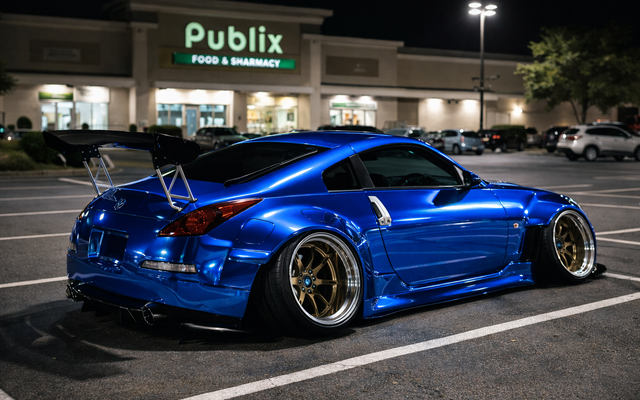
This American track weapon introduces a unique set of strengths to the drifting sport, featuring a light alloy frame, a transaxle-style gearbox and differential unit that contributes to an perfect front-to-rear mass ratio, and the tremendous low-end power of a large-displacement LS V8 motor. This combination transforms it into an absolute monster on track, able of entering and sustaining extended slides with apparently effortless deployment of throttle. For those desiring remarkable value, the 350Z model Nissan stands out as a prime choice. It arrives from the manufacturer with a robust chassis, a effective original LSD, and the free-revving VQ series powerplant that provides ample power and torque for practicing and moving up in the sport. Its follow-up, the Nissan 370Z, brings additional advancements in structural rigidity, handling precision, and overall engine performance, establishing its place as a popular selection among serious competitors. Additional legendary platforms that merit mention are the agile rotary-powered Mazda FC RX-7, the ubiquitous Nissan S13 240SX, the American SN95 generation Mustang, the electronic-equipped BMW E90, and the compact yet incredibly fun and instructive Mazda MX-5. Each of these platforms provides a different array of attributes, difficulties, and capabilities, but they all possess the fundamental elements necessary to be transformed into a competitive drift car.
However, picking the optimal platform is just the starting point. To unlock the complete capability of every of these cars, significant modifications to the steering system and chassis control systems are absolutely non-negotiable. This is where the realm of specialist tuning parts enters sharp focus. The single most transformative upgrade for a dedicated drift car is the integration of a drift-spec angle modification kit. These advanced systems, such as those manufactured by performance brands like SLR Speed, are designed to radically increase the chassis's possible turning lock. A OEM road car is severely limited in how far its front wheels can turn, a design compromise for on-road operation. In oversteer driving, but, extreme opposite lock is continuously needed to control and maintain a slide. An angle kit replaces the stock hubs, rod ends, and potentially suspension arms with components that allow the steered wheels to reach angles over 70 or even 80 degs, compared to a normal stock setting of around 40 to 50 °.
This immensely greater lock provides the operator with exponentially enhanced control during a slide, making it much more straightforward to start a oversteer moment, sustain it through a sweeping turn, and switch fluidly from one angle to the opposite. The difference in handling is nothing short of transformative. Combined with a correctly specified angle kit is the just as vital upgrade to the car's spring and damper setup. Off-the-shelf or even expensive street adjustable suspension are just not intended for the specific and extreme requirements of competitive oversteer. A dedicated pair of suspension units is paramount. These specialized suspension components have custom damping rates and spring rates that are designed for the violent load shifting that is typical of drifting. When a pilot starts a angle, the vehicle's mass is transferred violently to the front of the turn. Proper drift-spec coilovers control this shift in a controllable manner, enabling the vehicle to find its balance promptly and giving the operator precise feel through the wheel and cockpit. They also provide accurate setting of stance, shock absorber firmness, and weight balance, which are all integral parts of dialing in the chassis's dynamics to a given venue or driving approach. Together, a precision-engineered angle modification system and a expertly chosen pair of drift-spec coilovers form the core mechanical foundation upon which all subsequent tuning is built.
Once the core hardware is installed, the subsequent vital step in the build is the precise tuning of the car's suspension geometry. This is the domain of vehicle alignment optimization, a procedure that can appear daunting to the beginner but is, in fact, the key to transforming a set of high-performance components into a cohesive and predictable machine. The most debated element of suspension geometry for drifting is definitely negative camber. Camber angle is the angle of the rim in relation to the vertical plane when viewed from the front of the chassis. If the upper part of the tire is angled inward, this is known as inward tilt. In drifting, inward-leaning wheels on the front axle wheels is universally applied and is regarded as essential. The logic is intrinsically related to tire contact.
When a car is turning at extreme sideways angles, the body tilts towards the outside of the corner. This chassis roll causes the outer front tire to reduce its best footprint with the asphalt. By introducing an inward tilt, the wheel is pre-angled to compensate for this lean. As the car tilts into the corner, the outside front tire flattens out with the track, increasing its grip at the exact coilover setup tips time when it is absolutely essential for steering authority. Commonly, front axle camber settings for a dedicated drift machine fall between approximately -3 degrees to as much as -5 degrees or even more, depending on the specifics of the vehicle configuration, tire selection, and pilot style. The rear tires also employ negative camber, but the settings are generally less and more nuanced than the front. Excessive negative camber at the back can cause the vehicle to excessively loose and difficult to control on power application, as it reduces the effective contact patch of the driving wheels during linear acceleration. Therefore, rear axle adjustments are frequently in the ballpark of -1 degree to -3 degrees, finding a careful compromise between offering sufficient side grip to help in initiating and sustaining the angle while simultaneously maintaining good traction for acceleration the bend. Camber is merely one component of the larger suspension geometry picture, which additionally involves toe setting, caster angle, and bump steer correction.
Toe describes the direction of the wheels when looked at from a bird's-eye view. Positive toe means the leading edges of the tires are nearer together than the rear edges, while negative toe means the converse. For oversteer, a small amount of front negative toe is commonly run to sharpen the initial handling reaction, making the chassis feel more agile and willing to begin a slide. Rear toe angle is generally set to neutral or a incredibly slight amount of inward toe to foster predictability under power. caster angle is the longitudinal or aft inclination of the suspension pivot when viewed from the side-on of the car. Positive caster angle enhances self-centering and stability stability, and it furthermore boosts inward lean gain during steering, which is extremely beneficial. Adjusting these values is a intricate interplay where a adjustment to a single parameter can and will affect the others. The old-school approach for dialing in a chassis's suspension geometry for sliding has for a long time been a tedious affair of guesswork and adjustment. A driver or engineering group would apply a change based on a hunch, run the car on track, rely on the operator's personal feel and comments, and then make a further change. This process would repeat again and again until the car felt suspension engineering "acceptable" or the available testing time ended. This methodology is not only incredibly inefficient in terms of time and costs, but it is also deeply imprecise.
Human perception is a famously unreliable metric, colored by countless factors such as tiredness, evolving car alignment tuning track grip levels, weather, and just the mood of the driver on that particular day. What feels "tail-happy" on one run might feel "tight" on the subsequent pass, resulting in contradictory feedback and counterproductive tweaks. This long-standing problem in chassis setup is specifically where contemporary technology has intervened to completely change the landscape.
The advent and adoption of sophisticated vehicle dynamics tools has introduced a completely new age for engineering and optimizing competitive drift cars. This new generation of platforms, showcased by groundbreaking products like data acquisition tools, work by physically capturing the real-time dynamic performance of the car as it is being driven on the course. As opposed to depending on subjective feedback, these systems collect quantifiable data on key variables such as shock absorber movement, individual tire rotation, lateral and longitudinal g-forces, wheel angle, and accelerator and brake pedal position. This collected data stream is then interpreted by powerful algorithms that can visualize and interpret the data in a actionable way. For the very first time, drivers and builders can see exactly what the chassis is performing at any given point of a slide. This capability changes the complete chassis setup procedure. Consider the aforementioned challenge of optimizing the front camber for a given car. Rather than introducing a adjustment from -3 degrees to -3.5 degrees and then testing several runs to try and "feel" a change, a vehicle dynamics tool can provide immediate and clear information. The application can indicate visually how the suspension's grip is acting during the key stages of a slide: turn-in, holding the angle, and changing direction. It can demonstrate if the current angle is permitting the outside front tire to achieve ideal contact or if the rubber is overloaded on its outside edge.
The tool can subsequently provide fact-based suggestions for modification. Perhaps the telemetry indicates that the outside front tire is even overloading its edge at -3.5 degrees of negative camber, indicating that a move towards angle, say -4 degrees, might be beneficial. Conversely, the data might indicate that the tread is failing to achieving heat or that the inside edge is degrading unevenly, which could suggest that there is too much angle and a modest reduction back to -3.2 degrees would be better ideal. This degree of granularity and practical analysis was completely unattainable in the era of solely seat-of-the-pants adjustment.
The benefit of using a dedicated drift telemetry system goes far beyond just setting camber. It functions as an priceless coilover setup tips that is tailored to your particular chassis. When adjusting the rebound and compression values on your suspension, instead of using vague tips or copying another car's numbers, you can utilize the data to observe how the chassis is performing in reaction to your adjustments. The tool can graph the suspension travel data over a run, showing if the dampers are handling the chassis motion optimally or if they are permitting the car to become unsettled too much after a transition. It can help in identifying issues like bottoming out or excessive extension, allowing you to make informed adjustments to preload settings, damping values, or ride height. This approach applies similarly to the intricate task of car alignment tuning. In addition to camber angle, the system can offer insight into how modifications to toe and caster angle are impacting the chassis's balance during specific phases of a drift. For example, it can assist you to determine the ideal amount of front axle toe out for your individual steering geometry and driving technique by showing the quickness of turn-in response and the consistency of the vehicle at full lock. This transforms the software an incredibly effective performance optimization handbook that is dynamically informed by the live dynamics of your own vehicle on the tarmac. It moves the entire process from a subjective skill into a repeatable engineering process.
Moreover, the application of a system like GripDial is not at all restricted to professional engineers with vast budgets. For the amateur enthusiast, it functions as an powerful force multiplier. It effectively gives the driver with the knowledge of a expert suspension specialist without the associated cost. It speeds up the learning curve by providing clear answers to questions that would traditionally take countless track days of experience to solve. A builder can see how their particular car behaves to specific settings, building a deeper knowledge of suspension theory in the journey. It also democratizes advanced performance tuning principles, enabling every enthusiast with the desire to optimize their car to do so in a structured and successful fashion. This is especially important in a sport like drifting, where engineering knowledge has historically been a closely guarded advantage among professional drivers. Today, that knowledge can be in the hands of every motivated enthusiast.
In conclusion, the process to engineering and tuning the ultimate high-performance drift machine is a multi-stage mission that perfectly integrates proven hardware wisdom with cutting-edge telemetry tools. It begins with the informed choice of a proven car, then enhanced by the installation of non-negotiable drift-spec components like drift-spec steering angle kits and expertly specified performance adjustable dampers. The journey then progresses into the detailed phase of chassis dynamics adjustment, where settings like camber, toe setting, and caster angle are carefully adjusted to complement the vehicle's modified capabilities and the pilot's specific needs. Ultimately, and what truly differentiates the modern methodology from the traditional methods, is the adoption of a powerful vehicle dynamics tool. This platform eliminates the uncertainty and trial and error of purely feel-based setup by giving objective, actual information on how the chassis is actually behaving. It functions as an indispensable diagnostic aid, a definitive drift suspension tuning guide, and a master performance analyzer. Together, this holistic approach leads to that every aspect of the drift machine—from the pick of the car to the final adjustment on the suspension—is refined for maximum success on the competition venue. It embodies the full maturation of the art of drifting, merging physical pilot talent with surgical vehicle setup to forge the most dominant vehicles attainable.